
Market research
As part of a project supported by the Office for Economic Promotion and Innovation (SPEI) in collaboration with the Swiss Brewers Association (ASB), WasteOlas conducted a study involving more than 30 Swiss breweries to assess their interest in CO2 recycling.
We would like to extend our heartfelt thanks to everyone who participated, helping to shape the future of the brewing industry.
The study is licensed under a CC BY-SA 4.0 license
210 million liters of beer = 59%
of Swiss production
As part of a project supported by the Office for Economic Promotion and Innovation (SPEI) in collaboration with the Swiss Brewers Association (ASB), WasteOlas conducted a study involving more than 30 Swiss breweries to assess their interest in CO2 recycling.
Breakdown of Beer Production
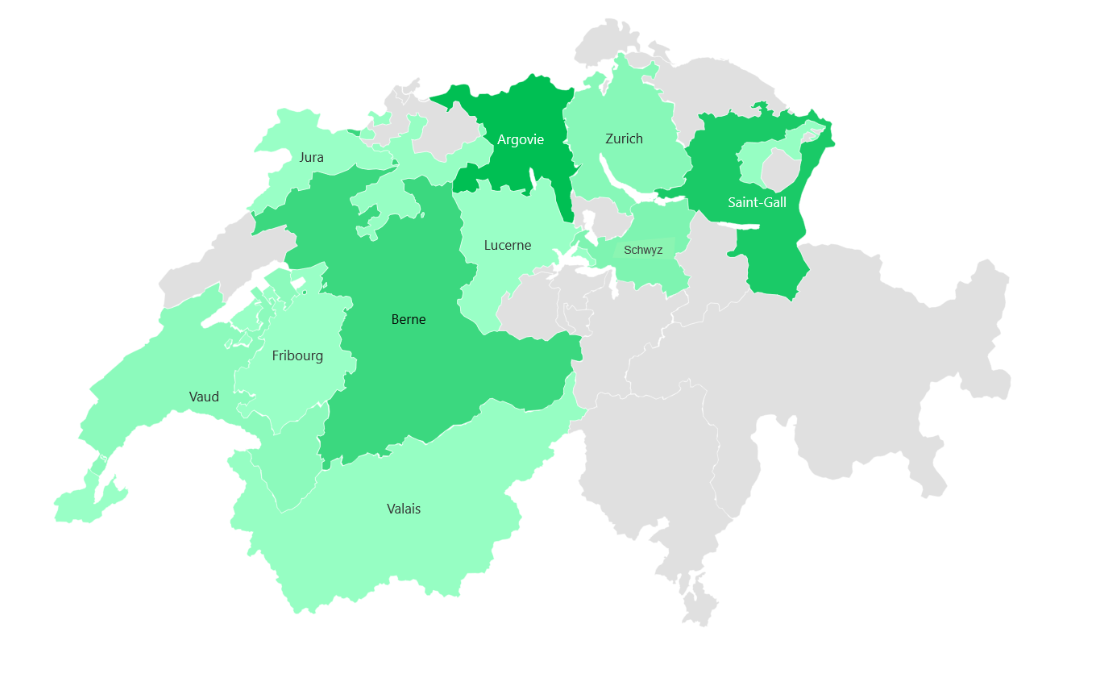
Counties included in the study
This geographic distribution highlights not only the diversity of Switzerland’s brewing industry, but also the widespread commitment of breweries to sustainable practices, such as CO2 recycling.
This overview deepens our understanding and helps us guide future initiatives to meet the diverse needs of breweries—whether small, medium, or large—regardless of their location.
CO2 recycling: an opportunity brewers are well aware of!
Most Swiss brewers are already aware of the potential of CO2 recycling in their production processes.
In fact, a significant number of participants indicated that they were not only familiar with this technology but also interested in applying it in their breweries
This result reflects the growing emphasis on sustainability in the brewing industry and highlights brewers’ willingness to adopt innovative practices that help reduce their carbon footprint.
The Need for CO2 Recycling in Breweries!
A significant number of breweries view CO2 recycling as a crucial step in addressing current environmental challenges and meeting their own sustainability goals.
This trend underscores the fact that CO2 recycling is seen not only as an opportunity but as a necessity for optimizing production processes and reducing the carbon footprint.
Brewers are now preparing to adopt effective, practical solutions to integrate this technology into their operations, thereby reaffirming their commitment to a more environmentally friendly and sustainable industry.
Size of breweries
Small breweries
They account for a significant portion of the industry and are often characterized by small-scale production and a personalized approach to brewing.
Major breweries
With significant production capacity, these breweries play a key role in large-scale distribution and industrial innovation.
Carbon footprint: an essential tool for tracking emissions reductions
Carbon footprint analysis is an essential tool for reducing one’s ecological footprint and measuring the impact of CO2 recycling. However, most breweries have not yet taken the plunge, a trend that is also evident in other economic sectors.
This assessment, which is currently voluntary, provides a comprehensive overview of a company’s or process’s greenhouse gas emissions, enabling the effective identification and targeting of reduction measures.
By taking action now, breweries can stay ahead of future regulations and gain a strategic advantage in the energy transition.
The Use of CO2 and Nitrogen in Brewing Processes
Most breweries use CO2 in their production processes. However, an interesting shift is underway: some breweries are beginning to replace CO2 with nitrogen (N2).
This gas is inert and does not emit greenhouse gases. It is produced directly at the brewery using a specialized air compressor, thereby reducing CO2 deliveries by truck. This solution is being considered as a way to gradually replace CO2 in certain brewery processes.