
This article draws on and summarizes the work of:
Mikko Sairanen, Leena Aarikka-Stenroos,
Low-carbon business models: Review and typology,
Industrial Marketing Management, Volume 123, 2024, Pages 222-250, ISSN 0019-8501.
Changes made: summary, adaptation, translation into French, contextualization for WasteOlas.
Adapted summary
Global efforts to combat the climate crisis are pushing companies to decarbonize their operations and align their business models with a low-carbon approach. However, there are few practical overviews of business models that can create value while reducing the carbon footprint of supply chains.
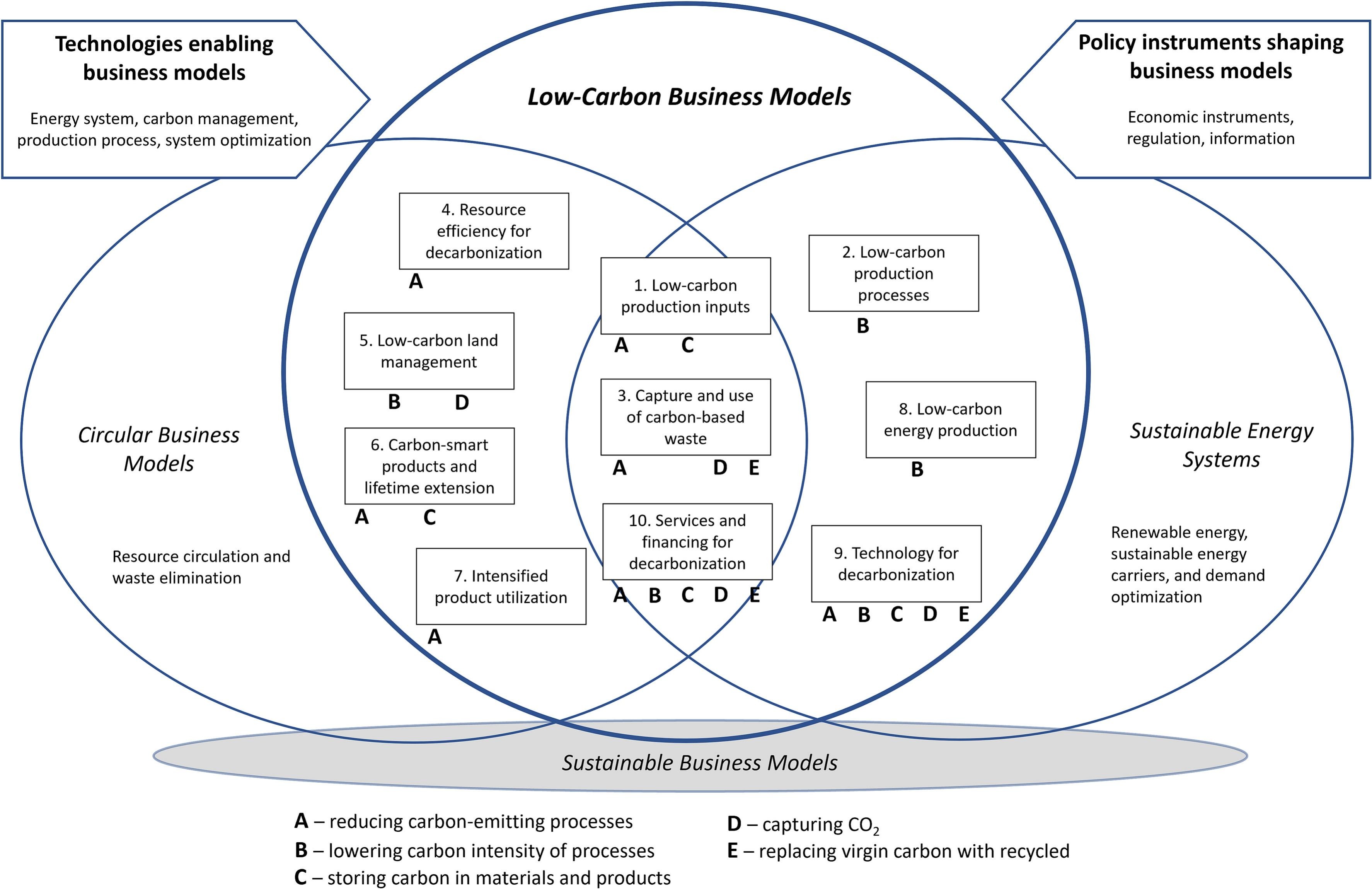
The article by Sairanen & Aarikka-Stenroos (2024) presents a typology of 10 low-carbon business models, based on an analysis of 143 scientific articles and 49 industry and policy reports. These models cover the full range of decarbonization strategies, from internal optimization to facilitating decarbonization among customers or partners.
The 10 low-carbon business models identified:
- Low-carbon production inputs: recycled, renewable, or low-carbon raw materials and energy sources.
- Processus de production bas carbone : transformation des procédés industriels (électrification, captage du CO2, etc.).
- Carbon waste utilization: capture, use, or resale of carbon emissions and byproducts.
- Resource efficiency: optimizing the use of materials and energy.
- Low-carbon land management: regenerative agriculture, sustainable forestry, soil conservation.
- “Carbon-smart” products and extended product life: designing products that are durable, recyclable, and reusable.
- Increased product usage: sharing models, servitization (“product-as-a-service”).
- Low-carbon energy production: development and sale of renewable energy or advanced fuels.
- Decarbonization technologies: equipment and technological solutions for the low-carbon transition.
- Services and financing for decarbonization: consulting, platforms, financing, and carbon offsetting.
Application to WasteOlas
For WasteOlas, this classification provides a framework for:
- Identify new areas for growth (CO2 utilization, consulting services, carbon offset platforms, technological solutions, etc.)
- Structure the offering around circularity and energy efficiency.
- Highlight the environmental impact to industrial and institutional clients.
For more information, see the original article (in English):
Summary adapted and translated by WasteOlas from the article under license CC BY 4.0.
Modifications: summary, adaptation, translation, contextualization.
No endorsement or validation by the original authors is implied.