Un Prix Nobel tourné vers l’environnement
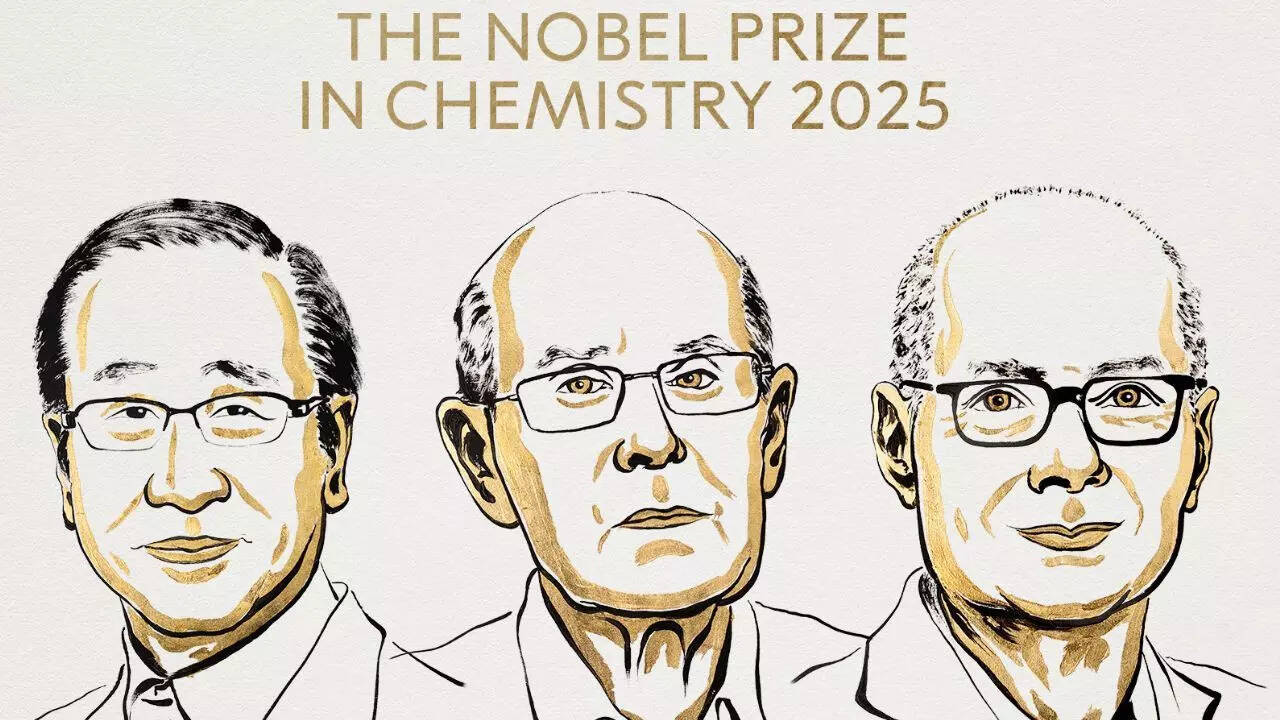
The 2025 Nobel Prize in Chemistry has been awarded to Omar M. Yaghi, Susumu Kitagawa, and Makoto Fujita for their pioneering work on metal-organic frameworks (MOFs), porous materials with remarkable properties. This award, officially announced by the Royal Swedish Academy of Sciences, highlights the importance of scientific solutions to environmental challenges, particularly the fight against greenhouse gas emissions. The research conducted by these three scientists has led to the development of structures capable of efficiently capturing and storing carbon dioxide (CO₂), thereby paving the way for new industrial and environmental applications.
MOFs: Porous Materials with Exceptional Properties
MOFs are crystalline structures composed of metal nodes linked by organic ligands, forming a highly porous network. This architecture gives them an extremely large internal surface area, ideal for gas adsorption. Their ability to selectively trap CO₂, even at low concentrations, makes them tools of choice for air purification and reducing the industrial carbon footprint.
Capturing and Utilizing CO₂: A Major Challenge for the Planet
International recognition of MOFs highlights their potential in the fight against climate change. Beyond simple capture, these materials open up the possibility of utilizing captured CO₂, for example by converting it into chemicals or fuels. This approach fosters the emergence of a circular carbon economy, where emissions are no longer merely waste to be disposed of, but a resource to be harnessed.
WasteOlas and the MOFs: A Partnership for Innovation
At WasteOlas, we develop innovative solutions for capturing and utilizing industrial emissions. The integration of MOFs into our technologies represents a major opportunity to improve the efficiency of our systems. Thanks to their exceptional adsorption capacity, MOFs could significantly increase the amount of CO₂ captured and facilitate its conversion into valuable resources. This synergy between scientific advances and industrial innovation places WasteOlas at the forefront of sustainable solutions for the environment.
Toward a circular carbon economy
The awarding of the Nobel Prize in Chemistry to MOFs marks a key milestone in the transition toward a more environmentally friendly economy. By combining recent scientific discoveries with WasteOlas’s expertise, it becomes possible to turn climate challenges into opportunities for sustainable development. MOFs are thus establishing themselves as essential partners in building a future where greenhouse gas emissions management goes hand in hand with innovation and responsibility.
Sources :
- “The Nobel Prize in Chemistry recognizes the discovery of porous materials with crucial environmental applications,” Le Temps, https://www.letemps.ch/sciences/le-nobel-de-chimie-couronne-la-decouverte-de-materiaux-poreux-aux-applications-environnementales-decisives
- Official announcement of the 2025 Nobel Prize in Chemistry, https://www.nobelprize.org/uploads/2025/10/press-chemistryprize2025.pdf
Illustration : Niklas Elmehed © Nobel Prize Outreach