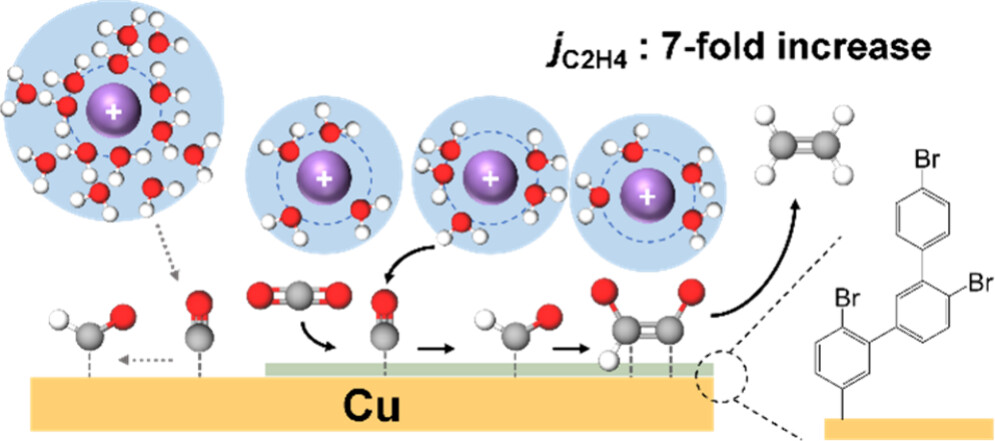
EPFL researchers have developed a new method to improve the efficiency of electrochemical CO₂ reduction. By using a thin layer of organic molecules attached to the catalyst’s surface, they are able to partially dehydrate cations in solution, which increases the reaction rate and selectivity towards complex chemical products (C2+).
This advancement is fully aligned with the field of CCU (Carbon Capture and Utilization), which aims to capture CO₂ and transform it into useful resources, such as fuels or raw materials for the chemical industry. By facilitating the conversion of CO₂ into high-value-added products, this technology contributes to the circular economy and the transition towards more sustainable and environmentally friendly industrial processes.
To learn more, consult the original article (published under CC-BY 4.0 license):